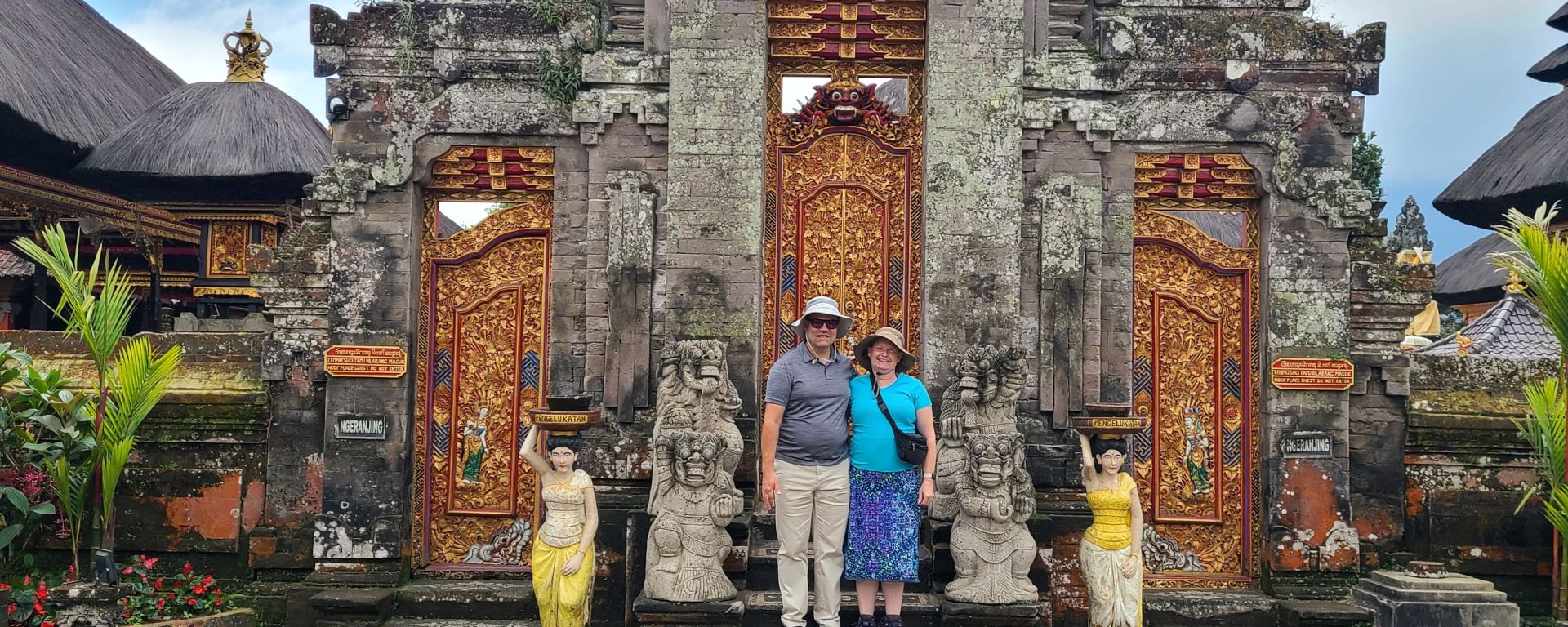
We did some traveling this summer. Embracing the idea that life is an adventure, along with some questionable planning, we ended up in 10 airports on four continents over six weeks in June and July. Our travel spanned 17 time zones. We encountered five languages. I took about 6,000 photos. It was an embarrassingly fantastic summer.
We talked to people in England and Indonesia and Australia, along with folks from Japan and Denmark and the Netherlands. They told us about their families, their cultures, their homes. We talked of travel, and heritage, and religion, and (a little) politics. It’s interesting to visit places that have a single, dominant religion. In Lombok, just about everyone is Muslim. Their faith is a part of their everyday lives. It’s an integral part of their culture. That extends beyond the ubiquitous calls to prayer and head coverings. Their religion is part of who they are. Similarly, almost everyone in Bali is Hindu. There’s a shrine in every home, and three temples in every village. Prayer and offerings are everywhere. It’s obvious to anyone who visits that these are Hindu communities.

And yet, we were very surprised at their acceptance of others who don’t share their faith. We felt genuinely welcome, even when we got Brahma and Vishnu and Shiva mixed up. Our tour guide would make an offering and say a short, quiet prayer for our safe journey before guiding us up the volcano, but he didn’t expect us to participate. We could wear shorts and have bare shoulders and uncovered heads, as long as we weren’t going inside sacred spaces dressed like that. Even the idea that Bali could be a Hindu island in the extremely-Muslim Indonesia is surprising. In Bali, 87% of the population identifies as Hindu, while that number is 1.7% in the rest of Indonesia. I asked guides in both Bali and Lombok if there is any friction caused by the religious differences. They were all surprised at the question. We have our faith. They have theirs. There’s not reason why we can’t co-exist.
Compare that to England, where we started our travel this summer. It was my first tour of Westminster Abbey. The verger guiding our tour pointed out a lot of destruction that the abbey saw during the reformation. The church was founded almost 600 years before Henry VIII separated from the Catholic church. The reformation sparked a significant amount of destruction at the abbey in the form of vandalism and looting, much of which was never rebuilt. Henry VIII’s daughter, Mary I, ordered the execution of 283 dissenters who opposed her attempts to reunify with the Catholic church. These two variations of the Western tradition of Christianity have been at odds for 500 years, missing the fact that they actually agree on almost all of their theology.
Here in the land of the free, we have a country that has always claimed to protect religious diversity. The story of the pilgrims starts with an attempt to escape religious persecution. Our country’s founding documents secure the rights of religious freedom, while the writing of our early leaders clearly illuminates the struggle we’ve had with this idea from the very beginning. We seem to get stuck on the idea that religious freedom extends to the ability to control the actions and beliefs of others. The easiest way to see this is to reverse the roles. If you think posting the 10 commandments on classroom walls is a good idea, but you oppose the posting of the 5 Yamas in those same classrooms, then you don’t really believe in religious freedom.
In talking with people from all over the world this summer, it was startling to see common threads running through all of the cultural diversity. We all want the same things. We want happiness and contentment. We want prosperity for our children. We want peace. That’s pretty much what it boils down to. How do we help our children thrive? We differ in our approaches and priorities. Many consider faith to be a major component. Most consider education to be important. But we differ widely on what that education should include. Do we need our kids to know lots of stuff? Do we want them to be innovative, resilient, compassionate, and curious? Is technology really “the way of the future?” How important is it to get into a “good college” and what are the steps we have to take to improve our chances? And perhaps most importantly, is prosperity finite? Does one person’s success only come from the failure of others?
If you see this as a zero-sum game, prosperity becomes extremely competitive. If you believe that there’s one pie, and you want as large a piece as you can get, you’re going to spend at least some of your time making sure others get the smallest pieces possible. But what if the size of the pie isn’t the limiting factor? What if we can make a bigger pie?
I used to think technology was an equalizer. With easy access to an abundance of information, and easy access to the means of publication and dissemination, everyone would have equal access to the means for sharing ideas, perspectives, and questions. These days, I’m not so sure it has worked out that way. These tools are increasingly weaponized to sow disinformation and discredit valid, reasonable positions. The cacophony of the Internet has made it even harder for the voiceless to be heard. While we work to make a bigger pie, the work to get a larger piece of that bigger pie is also escalating.
I don’t know that I have a solution beyond this: if you are a person of faith, go back to the foundational principles of your faith. Look to see what it says about how to treat other people. Because we all have the same goals. And hate, discrimination, and persecution aren’t the ways to achieve them.
 Taste of Tech