
“Has your district implemented any AI literacy materials for staff and/or students?”
It’s a reasonable question. I was in a virtual meeting with about 60 other educators earlier this week. We were talking about artificial intelligence, and how schools are working to embrace it, manage it, leverage it, govern it. It’s a working group. We’re trying to figure things out. There are no right answers. There are no wrong questions.
That was the wrong question.
Artificial Intelligence is the latest shiny thing. Everyone is excited about it. It’s going to save us so much time. It’s going to take care of the busywork of education, so we can focus on the real work of meeting each student’s needs and helping every student thrive. It’s going to help tailor instructional experiences to the needs of each student, and adapt to their needs as their learning progresses. It’s going to help students create new things and have new experiences that bring their learning to life in engaging, relevant ways.
At the same time, it’s going to call into question what we teach, how we teach it, and how we measure it. A generation ago, Google reduced the need for students to focus on recall. They don’t need to remember as much stuff as we did when we were in school, because they have a device in their pockets that has most of the knowledge in it. Our students don’t have to memorize nearly as much stuff as we did. So we adjusted our focus to do more. Our students leaned to categorize, classify, and compare. They learned to identify patterns, make generalizations, and draw connections between disparate ideas. They acquired the skills needed to apply the knowlege that they had rather than just repeating it. We’ve done a lot of good work over the last 20 years.
But now, AI can do that for them. Just like Google reduced the need for students to remember stuff, AI is making it much easier to understand, describe, and explain. It can compare and classify and identify patterns for us. That gives us the capacity to focus on strategic and extended thinking, where we apply that understanding to create new solutions to complex problems.
But we don’t get there by making our students “AI Literate,” whatever that is. They’re not even “virtual reality literate yet.” And that’s not even scratching the surface of “robotics literate,” “drone literate,” “coding literate,” “makerspace literate,” or “information abundance literate.” At this point, I’d settle for “literate.”
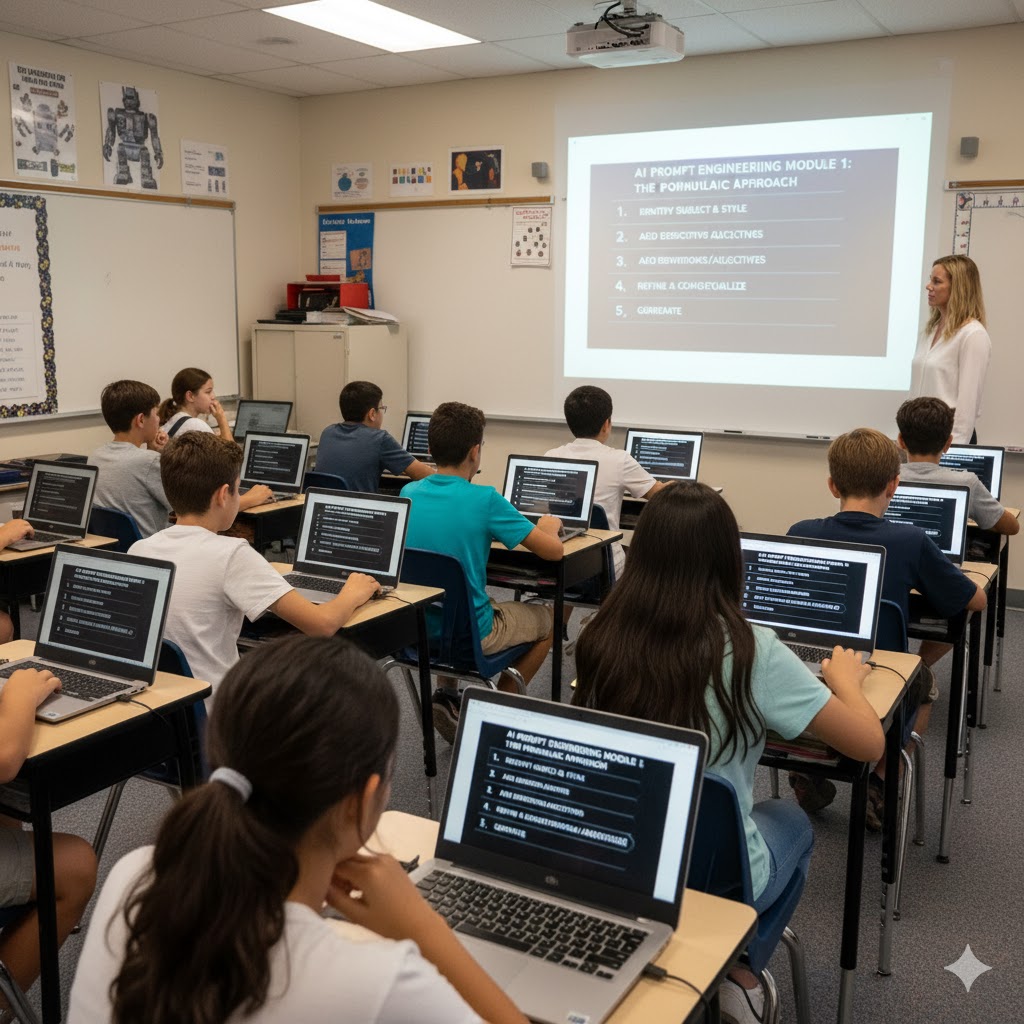
We have to stop reacting to each new thing by changing what we’re teaching. Our kids aren’t going to be more “career ready” five years from now if they have an “AI Prompt Engineering” certification from middle school. The world is changing too quickly for that. Think about the technology you learned to use in school. How is that helping you now? I can tell you that my Turbo Pascal and PFS:Write training are not significant contributors to my success in my current role. But you know what DOES help? My ability to think critically for myself is pretty useful. My tendency to apply knowlege and solutions to different domains helps a lot. My skills at communicating effectively, and identifying bias and disinformation are immensely valuable. And my tendency to figure out new things that I’m interested in without needing a tutorial or class puts me miles ahead of others. Those are useful skills.
We have to teach our students how to learn. We have to give them the resources and the drive to learn new things on their own. And we have to infect them with a thirst for new ideas that drives them to embrace learning. That’s how we help them thrive.
We have to cultivate curiosity.
 Taste of Tech