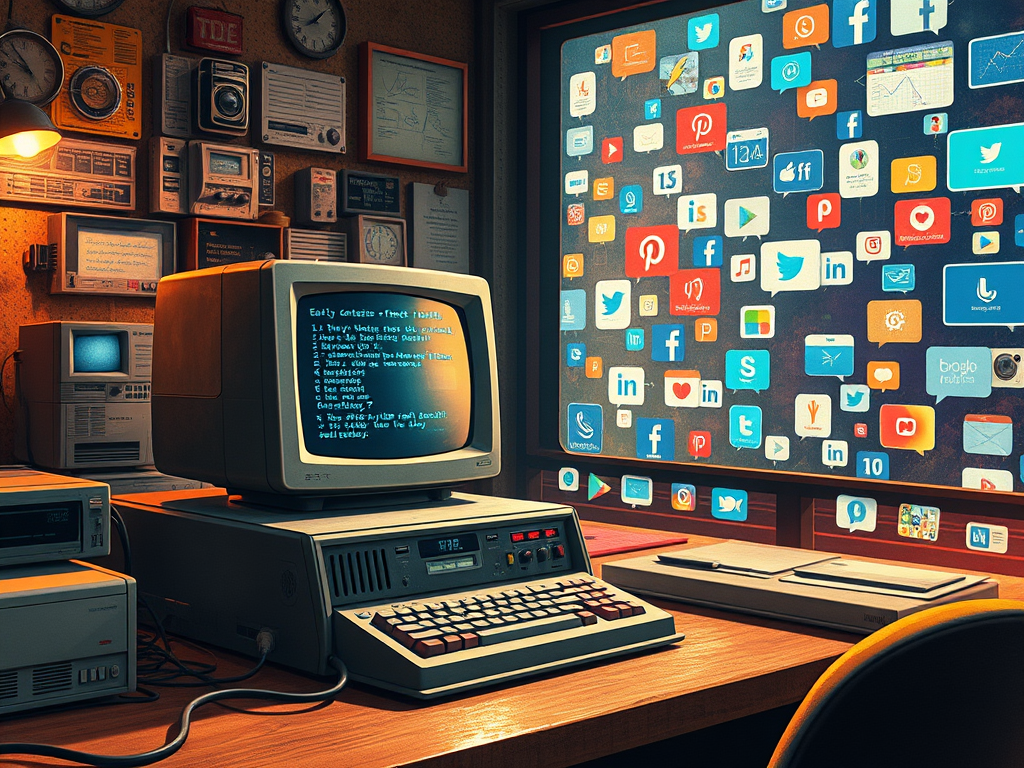
“No unread messages in conversations or conferences”
It was the message, all those years ago, in the world of dialup and text conferencing, that told you it was time to log off and go do something else. “There’s nothing to see here. You’ve already read everything.” There’s no email to read. There are no new posts in the online communities. You’re at the end. No more Internet for you.
Even then, it was hard to accept that. We could, of course, create a NEW conversation. Or we could continue an old one, replying to something someone else had posted. Or, we could jump out of CoSy and switch to chat if there were others online at the same time. There was something compelling about staying in that digital space, even if the software wasn’t actively trying to hold onto you. This was a conferencing system on a university bulletin board. Nobody was monetizing the Internet yet. We weren’t really even trying to figure out this new digital world and its implications for how we would work, learn, and interact in the new century. We were just trying to connect with others.
The web came later. And America Online, the Information Superhighway, everything dot com. The collaborative space turned into an information resource. Suddenly, we were overwhelmed with information. We could get our questions answered. The age of wonder gave in to the age of wander as we surfed the web and learned all kinds of new things.
Some of those things we learned weren’t true.
In the beginning, it was a problem of misinformation. Someone would post something that they didn’t fully understand. Others would see that and repeat it, lending their own credibility to whatever it was. We taught students how to assess the reliability of the things they found online, and we worked hard to instill a sense of skepticism. It wasn’t enough.
When social media came along, we connected with people in new ways. We friended them on Facebook. We followed them on Twitter. We subscribed to them on Youtube. When we went to those sites, we saw the content from the people that we chose to follow. We were responsible for curating our own networks, our own sources for information. And this model mostly worked. But as these tools grew, we started missing things. If I have 100 friends on Facebook, and they’re all posting things every day, there’s no way I can keep up with that. So Facebook moved away from the strict chronological feed that shows everything my friends have posted, with the most recent ones first. It used an algorithm to show me the things I am most likely to be interested in. To figure this out, it used what it knew about me: what types of things did I frequently engage with? What did I comment on? What did I like? Whose posts tended to resonate with me more? In short, what were the things that kept me on the site? And they quickly realized that they could include things that didn’t come from my friends. Some of these are fascinating, engaging posts from other people that I might be interested in. And some of those other people might be paying to show up in my feed.
Because that’s really the bottom line: community engagement is the goal for social media. Above everything else, they want to keep you on the site. That’s where the money is. They can’t advertise to you if you put down your phone and go do something else. All of these tools — the Facebooks and Youtubes and TikToks and Instragrams and Twitters — are owned by for-profit companies that are trying to make money. The only viable revenue stream for them is advertising. For advertising to work, they need you to stay on their platform for as long as possible. So the algorithm prioritizes that above everything else.
Now, what keeps people engaged? What kind of content gets you excited? For most people, it’s the stuff that pushes the boundaries. It’s the outrageous thing. It’s the extreme thing. It might make you excited in an awe-full or an awful way. It’s the thing that suggests that disaster is just around the corner. It’s the thing that contradicts what you’ve believed your whole life. It’s the thing that reinforces something you already think you know, and takes it to a new level. It’s the thing that creates fear. It’s the thing that pushes the boundaries of societal norms. When we engage with these things, we get a skewed view of the world. All teenagers are disrespectful. All drivers are maniacs. All Republicans are trying to destroy our country. All schools are ineffective. All Texans are lunatics. All SNAP recipients are entitled freeloaders. Several of those things aren’t actually true, but that doesn’t really matter. The algorithms actually promote disinformation, because it’s more likely to elicit a passionate response. Pushing people toward the accurate and reasonable is boring. And boring is not profitable.
We gave up control over the information we see. I’m no longer curating my own feed of information. An algorithm is doing that instead. And the algorithm’s sole purpose is to generate revenue for the platform it’s on by promoting engagement. It has no motivation for trying to restore civility. It has no allegiance to truth. It has no use for reconciliation.
This can all be fixed, but the fix isn’t easy. Regulation won’t get us there. It has to be MORE profitable for the online platforms to build civility into their algorithms. It has to be advantageous for them to promote credible content and demote unreliable or misleading information. There has to be a benefit to them to push people together instead of pulling them apart.
One approach is to lean on the integrity of the advertisers. If you’re trying to protect a brand, you want to be associated with high quality content. Advertisers may be more likely to spend money for placement next to reliable, truthful, reasonable content. No marketing manager wants “Conspiracy Theories sponsored by Pepsi.” But the reality is that this probably isn’t practical unless the users of the platform are willing to pay a subscription fee to be part of the community. Thus far, that hasn’t been a very lucritive online model. The content wants to be free, and the consumers expect it to be free. That’s baked in to the DNA of the Internet.
Maybe it’s time to log off and go do something else.
 Taste of Tech