Don’t Criticize What You Can’t Understand

When I was in school, we weren’t allowed to use calculators. We did our calculations by hand. That included long division, and deriving square roots, and looking up logarithms and trig functions in computation tables. It wasn’t until my senior year of high school that my physics teacher said, “you know, you could just use a calculator and save yourself a lot of time.” By … Continue reading Don’t Criticize What You Can’t Understand

Did I Really Write This?

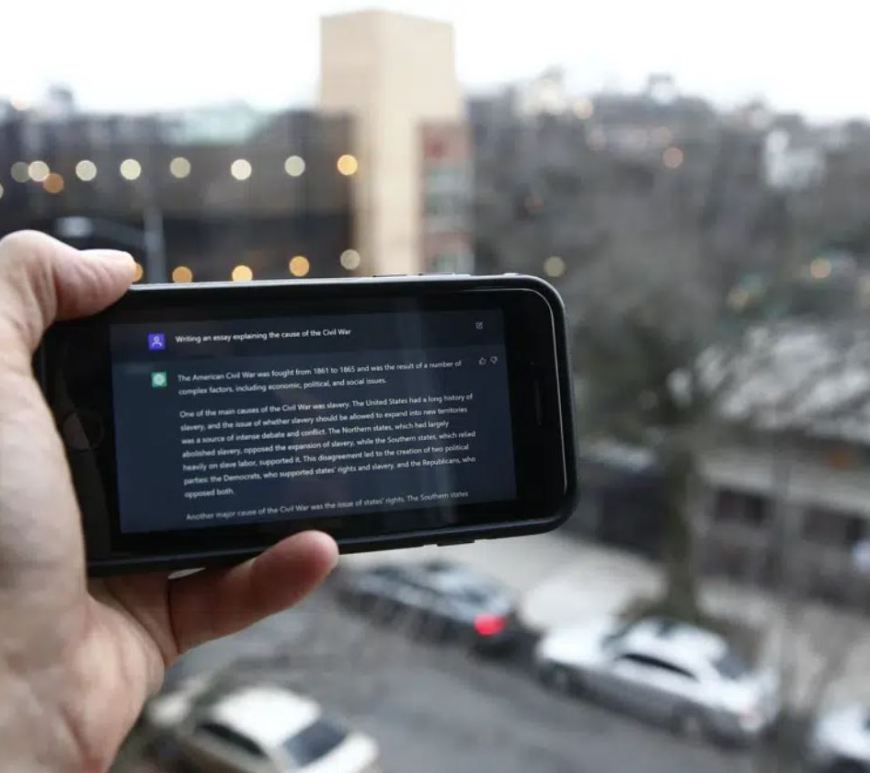
A few years ago, MSN fired all of their reporters and replaced them with artificial intelligence. “Reporters” might be the wrong word. MSN didn’t report their own news. They used other news sources, and curated their own news site based on the content that they gathered from other places. They found that this could be done just as easily by software as it can by … Continue reading Did I Really Write This?

Pencil Sharpeners

It was eight years ago now that I heard Richard Culatta speak at EduCon. At the time, he was the director of the Office of Educational Technology at the US Department of Education. Now, he’s the CEO of the International Society for Technology in Education. In his little talk in the cafeteria of the Science Leadership Academy all those years ago, Culatta talked about pencils. … Continue reading Pencil Sharpeners

Free Speech

This is going to be American-centric. I’m sorry about that. The assumptions I make about how the world works are shaped by my environment. I know they’re not always global perspectives. And in this case, that shows more than usual. We should probably start with the primary source. Here’s the text of the first amendment to the US Constitution: Congress shall make no law respecting … Continue reading Free Speech

The Problem of the Portrait

One of the recent trends in schools has been the creation of a “portrait of a graduate.” This is a process through which a school district, with input from students, teachers, administrators, parents, and community members, defines the characteristics we want our students to leave us with. Usually, an outside consultant is brought in to help the school through this process. The consultant helps brainstorm … Continue reading The Problem of the Portrait

Unzoomed

A few weeks ago, I had a request to remove Zoom from our student devices, and block students from reinstalling it. “We’re never going back to that,” the teacher explained. Apparently the fifth graders are using the chat function in Zoom to talk to one another, which she wants to stop. By “that,” she meant remote schooling. At the start of the pandemic, we leaned … Continue reading Unzoomed

Living the Vision

Last year, we spent a great deal of time crafting our portrait of a graduate. The trend in public education over the last several years has been to identify the characteristics that we would like our graduates to leave with. These characteristics — we call them “core competencies” — usually transcend any specific content standards. Ours is called the Vision of a Minuteman. We want … Continue reading Living the Vision

Friction

For years, I used the same company to buy most of my technology supplies. If I needed printers or cables or memory or consumables, I would always go there. The company had pre-negotiated contracts with several different agencies and consortia, so their pricing was reasonable. They had a fantastic database of products that allowed me to easily compare products and prices and options. Ordering was … Continue reading Friction

Blended Hybrid

Remember 21st Century Skills? Back at the turn of the century, we were all abuzz about the needs of our students as we moved into the new millennium. We knew we had moved from an industrial society to a service economy, and we were transitioning into the information age. We knew that schools had to adapt. And we had some pretty good ideas on what … Continue reading Blended Hybrid

The Starting Point

“I saw student choice. The kids were writing their own songs. It was definitely DOK-4.” We were debriefing an instructional rounds experience after observing a fourth grade music class. The teacher-observer was pretty insistent that this was engaged, student-directed learning that required students to employ extended thinking skills to create something new. “The students were all doing the same thing. The teacher walked them through … Continue reading The Starting Point