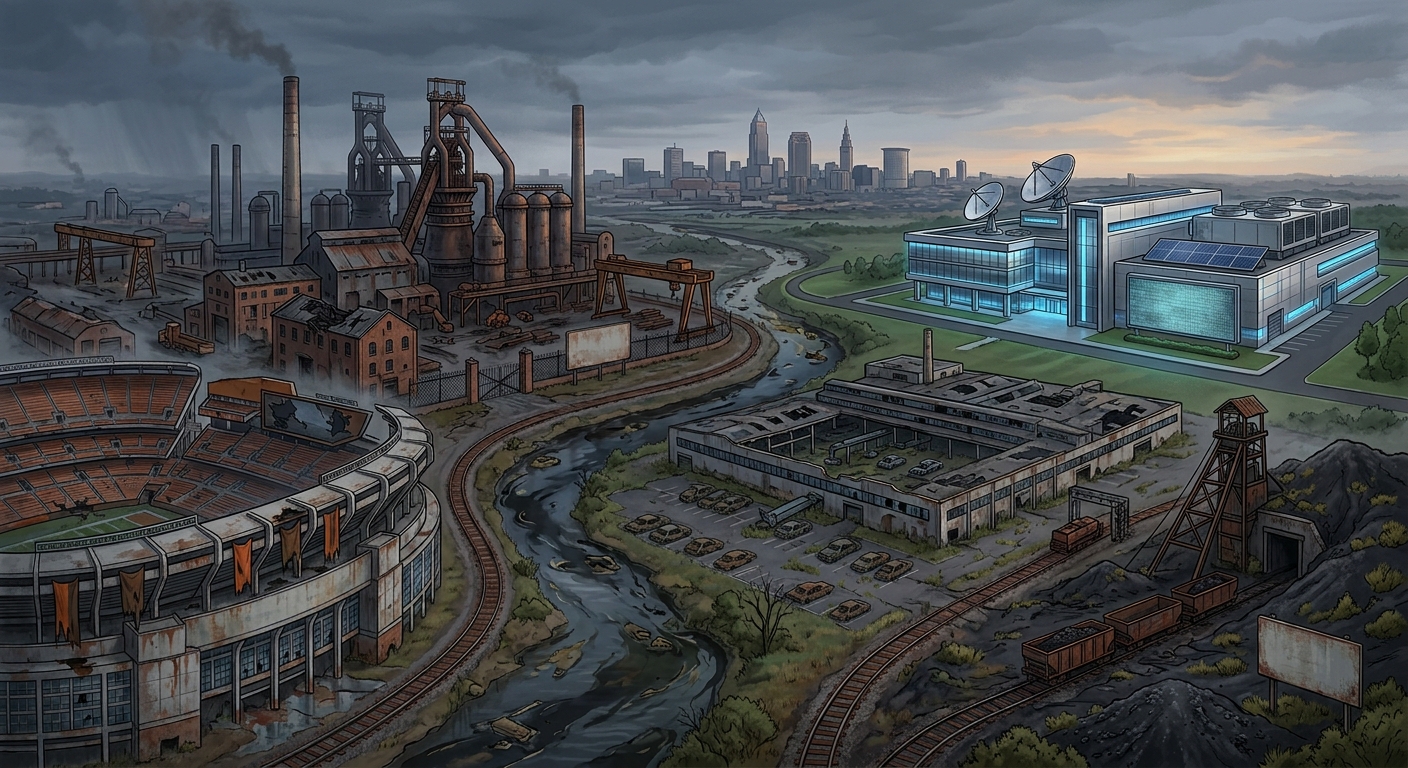
Mr. Watson came to Monongah in 1899 to sell the American Dream. His company would provide jobs. Families could have stable housing, enough to eat, and reliable wages. He was promising a better life for working families, built on industry, progress, and West Virginia’s richest coal seam.
Eight years later, the company town was providing basic housing for its workers at inflated prices. Wages were paid in company scrip, which could only be redeemed in the company store for overpriced food and supplies. Working conditions were dangerous. Hours were long. The future was grim. On December 6, 1907, an explosion in the mine killed more than 350 workers. And while safety regulations were later adopted, mining is still one of the most hazardous and volatile professions available to the working class.
In 1900, James Campbell co-founded the Youngstown Sheet & Tube Company, which became one of the largest steel manufacturers in the United States. Unlike competitors like Republic and U.S. Steel, Sheet & Tube was a locally owned company. It was to be a civic institution partnering with the community to bring long-term prosperity, steady employment, and industrial prestige to the area.
The reality of working conditions and wages didn’t quite live up to that ideal, though. Workers walked out when wages were cut during a time of record profits in 1916. Company guards fired into a crowd of striking workers, sparking a riot that killed three people and burned more than 30 structures. While conditions for workers improved after the riot, decades of corporate underinvestment left the aging plants unable to compete. The local ownership was lost when the company was purchased by the Lykes Corporation in 1969, and Lykes used the cash flow from Sheet & Tube to pay off debt rather than moderinizing. In 1977, the company abruptly shuttered its Campbell Works, throwing 5,000 workers out of work overnight and sparking the economic collapse of the entire region.
In 1966, General Motors opened a new, state-of-the-art assembly plant in Lordstown, Ohio. They promised that the plant would be a long-term engine to drive the regional economy, ensuring prosperity for generations of working families. Civic leaders showered GM with millions of dollars’ worth of tax incentives, and local and state governments funded expansive infrastructure improvements to accommodate the facility. As the steel mills closed in the 1970s, the GM plant served as a lifeline for working families. At its peak, the facility employed more than 10,000 workers.
But as the decades wore on, GM repeatedly threatened to close the plant unless major concessions were made. They forced workers to accept grueling line speeds and two-tiered wage structures while demanding steep tax breaks under the constant threat of moving production elsewhere. Ultimately, the plant was shuttered in 2019, eliminating the remaining 1,500 jobs and leaving behind a sprawling, 6-million-square-foot industrial shell that needed hundreds of millions in capital just to retool for future use.
When public funds were used to build a new stadium for the Cleveland Browns in the late 1990s, team owners and city officials promised the venue would anchor a vibrant downtown, spur local businesses, and act as an economic catalyst for the region. Since the stadium opened in 1999, the team has played 217 games, representing 2.2% of the days. For most of the year, the stadium sits empty, drawing heavily on municipal tax dollars for maintenance, monopolizing prime lakefront real estate, and generating virtually no long-term urban revitalization. In 2012, billionaire Jimmy Haslam bought the team, inheriting the public asset, its fanatical local devotion, and its abysmal on-field performance.
A decade later, the city offered more than $400 million in public funds to renovate the stadium and ensure its sustainability for the future. But the Haslams chose to abandon downtown Cleveland for a $2.4 billion dome in suburban Brook Park. They demanded $1.2 billion in public financing from state, county, and local taxpayers. Rather than delivering on the promised revitalization, the ownership group leveraged the community’s civic pride to extract public money for their private real estate empire. That leaves the City of Cleveland with a $300 million stadium that isn’t even 30 years old, costs nearly $3 million per year to maintain, and has no viable tenant.
Now, high tech companies are coming to the rescue. Amazon, Google, Meta, and others have proposed or are building enormous data centers across Ohio. In exchange for tax abatements, these data centers promise to lead Ohio into the 21st century. They’re promising hundreds of jobs during construction, with an ongoing workforce to actually run the data centers numbering in the dozens. They’ll need some infrastructure improvements, of course. The active proposals in Ohio would consume more than 11 gigawatts of power, which is about a third of all of the electricity that Ohio currently uses. That demand will make the recent 22% spike in electric bills seem insignificant. They also need a lot of water, even with closed-loop systems. Estimates vary, but total water consumption in Ohio could increase by more than 10%. And the wastewater produced by these plants contains heavy anti-corrosive chemicals, anti-foaming agents, and biocides that have significant environmental impact.
Unlike the previous generations, though, there’s no benefit for the community. They’re not promising a better life for our workers. They’re not committed to civic engagement. They’re not trying to make this a better place to live. They just want cheap land and resources to exploit. And when newer technologies and better opportunities come along, we’ll be left with a tech-industrial wasteland.

