
Last month, The Viridian Bookshop owner Chanel Bush noticed that something was wrong. Business had been incredibly slow for several weeks. While regular customers would come in occasionally, there weren’t many new customers stopping by. She thought she had done something to drive people away, because store traffic had declined so dramatically. On July 17, a customer pointed out that Google AI was reporting that Bush’s shop was permanently closed. Several other customers in the store pulled out their phones and checked, and they also found that Google listed the store as permanently closed and at a different address from where it actually is.
It’s not permanently closed. It’s not even temporarily closed. Their web site is active. They post events reqularly on social media. They claimed their business on Google and Yelp. They’ve done everything right to have a positive, active online presence. They asked supporters who see the message to report it as inaccurate. But in the meantime, people started posting in local Facebook groups. Citing the incorrect Google listing, they reported that the bookshop is closed. And as those posts gained traction, it reinforced the misinformation. Bush noted that visitors to the store thought that it was under new management because they were suddenly open again.
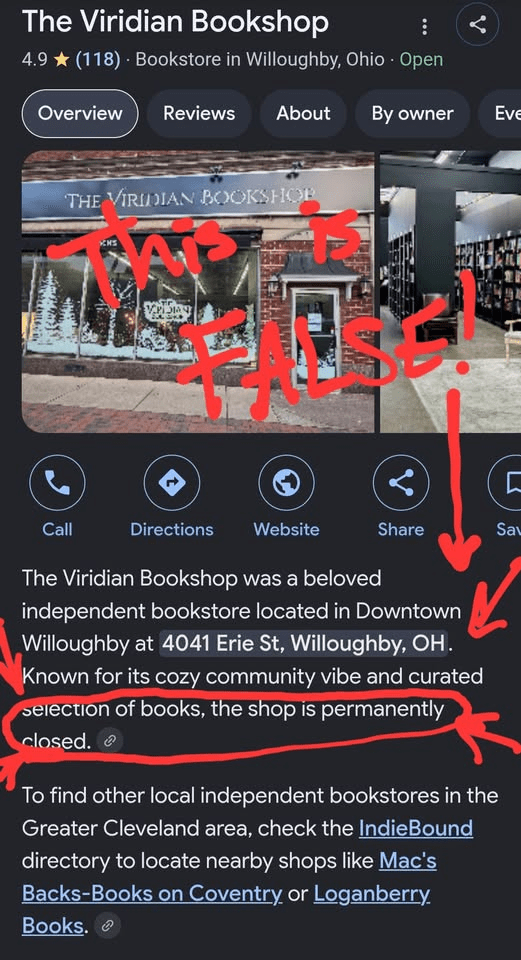
There’s no customer service line to call with issues like this. There’s no way to find out how the AI system determined that the shop was closed. And even if you engage with the AI engine and get it to recognize that it’s wrong, that doesn’t necessarily mean it will stop giving misinformation to other people. Viridian reached out to their online community, and asked people to report the issue, interact with their online pages, and even visit their store. Google uses all kinds of analytics, and the more they see people actually interacting with the business, the more likely they are to conclude that the store is open and active.
And it worked! Within a week, Google had corrected the false information and was showing accurate results. All it took was an army of passionate, committed book readers to reach out to Google to tell them that they were wrong, and the problem was fixed. That lasted three days. Then, Google reverted to the wrong information again. The algorithms can’t explain how they arrive at their conclusions, and their explanations change every time you ask. Remember that generative AI gives you plausible responses, not necessarily accurate ones.
I’m not a consipracy theorist. I think this is a mistake. It’s an algorithm that needs adjustment, or it’s sloppy coding somewhere, or it’s a system making assumptions based on invalid or unreliable data. Maybe it’s over-relying on individual reports without validating them. But this is the information we rely on. When you do a Google search, how much time do you spend digging in and making sure that the AI summary is correct? I’ve been teaching kids for thirty years to be skeptical of things they read on the Internet. I know better. But every question I ask Google isn’t a dissertation topic. I just need a quick answer. And we don’t have the tools to separate actual, reliable information from fictional slop. They look the same. They’re presented with the same authority and confidence. And there are no consequences for Google if they get it wrong.
A faint voice is nagging in the back of my brain, wondering if Mac’s Backs or Loganberry spends more on Google ads than Viridian. I don’t know anything about any of these stores, but it would be so easy for Google to redirect customers like this, and just apologize for the mistake if they’re caught. Recall that Google told avertisers in mid-January that they could buy advertising embedded in Gemini-powered search results. I don’t know that they would necessarily use disinformation to promote their partners, but there’s no reason why they couldn’t do that, and Google could definitely profit from this “honest mistake.”
So maybe we should turn off all of those AI summaries until there’s some assurance that they’re accurate enough to be trusted. Maybe we should just go back to using AI to help us organize our own thoughts and articulate them more clearly instead of relying on it to summarize ideas that aren’t our own. After all, we know what we mean, right? If AI mischaracterizes our perspectives, we’re sure to notice.
Or are we?
The Guardian reported last month that AI tools are subtly changing the messaging on politically sensitive topics to insert its own bias. Researchers examined the large language models of xAI, Meta, Google, the Chinese Alibaba, and the French Mistral. They found the introduction of bias to be pervasive. Quoting the Guardian article:
The AIs from Meta, Google, Alibaba and Mistral tended to rewrite humans’ posts with a liberal bias, for example on topics such as feminism, climate change, gun control and the legalisation of marijuana. Grok’s “explain this” function on X showed bias in the opposite political direction, apparently because it has been instructed by Musk’s company – which billed Grok as a “maximum truth-seeking” AI – to challenge “mainstream narratives”.
The tools routinely make adjustments to texts about religion, climate change, abortion, same-sex marriage, and political trends. While most of these changes are subtle, it’s clear that they are actively trying to put their thumbs on the balance of public discourse. If we ask AI to summarize or synthesize information from multiple sources, we can no longer depend on it to give us an accurate view of those resource. And when we ask it to help us with our own writing, it’s pretty likely that it’s going to nudge our perspective toward its developer’s own bias.
It took about 20 years to weaponize the Internet. It took about 10 years to weaponize social media. It took less than 5 years to weaponize artificial intelligence. We have to create curious, critical consumers of information. We have to have students who challenge the things that are presented to them as unquestionable fact. We need a populace who doesn’t just “take their word for it.” Information literacy is not the most important thing schools teach. But it’s right behind reading and writing.


What’s even worse is with the abundance of written AI slop on the internet students are beginning to see AI writing as good examples of writing. Bodes well for the future 🤣🤣